|
Consummatum Est! Christ is Risen, Alleluia!
(Many thanks to Justin for his dedicated project, he never missed a poem for us!) Easter Wings By George Herbert Lord, who createdst man in wealth and store, Though foolishly he lost the same, Decaying more and more, Till he became Most poore: With thee O let me rise As larks, harmoniously, And sing this day thy victories: Then shall the fall further the flight in me. My tender age in sorrow did beginne And still with sicknesses and shame. Thou didst so punish sinne, That I became Most thinne. With thee Let me combine, And feel thy victorie: For, if I imp my wing on thine, Affliction shall advance the flight in me. 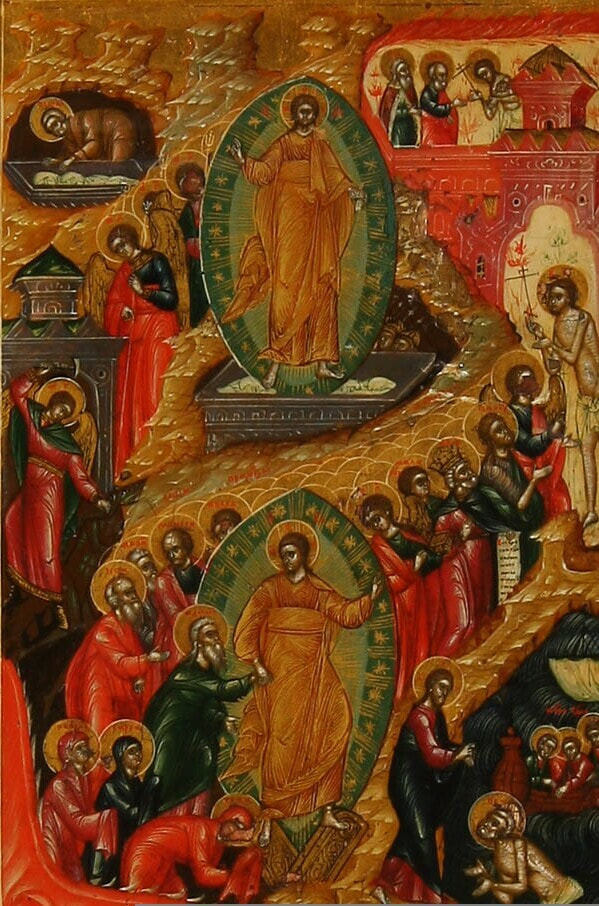 Dear Friends,
Today is the only day of the year that we have no liturgy. Perhaps it's because the mystery of what happened on this day has not yet been revealed to us. After all, the Church celebrates only what has been revealed - and otherwise she keeps silent. S Peter, though, in his first Epistle gave a tiny clue into the mystery of this day:
I know, not very helpful. This moment that S Peter hints at has been called (in the Apostle's Creed), his "descent into hell." More dramatically, in the medieval Church, it became known as the "Harrowing of Hell." It is the moment when Christ set free all the faithful souls that had gone before him. This poem is a reflection on the many famous icons of the resurrection in the Eastern church, which are actually icons of Holy Saturday. In them one sees Christ reaching out his hands to Adam and Eve, bringing them out of their ancient sarcophagi. And usually included in the icons are all the great saints of the Old Testament. One beautiful little detail in many of these icons is the character of Didmas. Didmas was the repentant thief whom Christ said he would see in Paradise. In the top right corner of the icon here, you can see Didmas being the first one greeted in paradise by Enoch and Elijah. Ikon: The Harrowing of Hell By Denise Levertov Down through the tomb's inward arch He has shouldered out into Limbo to gather them, dazed, from dreamless slumber: the merciful dead, the prophets, the innocents just His own age and those unnumbered others waiting here unaware, in an endless void He is ending now, stooping to tug at their hands, to pull them from their sarcophagi, dazzled, almost unwilling. Didmas, neighbour in death, Golgotha dust still streaked on the dried sweat of his body no one had washed and anointed, is here, for sequence is not known in Limbo; the promise, given from cross to cross at noon, arches beyond sunset and dawn. All these He will swiftly lead to the Paradise road: they are safe. That done, there must take place that struggle no human presumes to picture: living, dying, descending to rescue the just from shadow, were lesser travails than this: to break through earth and stone of the faithless world back to the cold sepulchre, tearstained stifling shroud; to break from them back into breath and heartbeat, and walk the world again, closed into days and weeks again, wounds of His anguish open, and Spirit streaming through every cell of flesh so that if mortal sight could bear to perceive it, it would be seen His mortal flesh was lit from within, now, and aching for home. He must return, first, in Divine patience, and know hunger again, and give to humble friends the joy of giving Him food--fish and a honeycomb. Dear friends,
On this most solemn day I offer a much longer poem, but it is worth the effort. It is an excerpt from one of the first poems ever written in English, likely in the 8th century. The word "rood" was an early medieval name for the cross of Christ, it comes from the same word we use for "rod." The poem's narrator is the Cross itself. One can hear the very particular voice of an early Anglo-Saxon Christian, writing with the pagan Norse in mind - those who still clung to the old dying magic, even two centuries after S Augustine's arrival in England. Trees, particularly the Yggdrasil, were very significant in Norse mythology, and the writer of this poem clearly wants to convert the pagan image to Christ. From “The Dream of the Rood” 8th C Anglo-Saxon, trans. By Richard Hammer The Rood (the cross of Christ) speaks: “It was long past – I still remember it – That I was cut down at the copse’s end, Moved from my root. Strong enemies there took me, Told me to hold aloft their criminals, Made me a spectacle. Men carried me Upon their shoulders, set me on a hill, A host of enemies there fastened me. “And then I saw the Lord of all mankind Hasten with eager zeal that He might mount Upon me. I durst not against God’s word Bend down or break, when I saw tremble all The surface of the earth. Although I might Have struck down all the foes, yet stood I fast. “Then the young hero (who was God almighty) Got ready, resolute and strong in heart. He climbed onto the lofty gallows-tree, Bold in the sight of many watching men, When He intended to redeem mankind. I trembled as the warrior embraced me. But still I dared not bend down to the earth, Fall to the ground. Upright I had to stand. “A rood I was raised up; and I held high The noble King, the Lord of heaven above. I dared not stoop. They pierced me with dark nails; The scars can still be clearly seen on me, The open wounds of malice. Yet might I Not harm them. They reviled us both together. I was made wet all over with the blood Which poured out from his side, after He had Sent forth His spirit. And I underwent Full many a dire experience on that hill. I saw the God of hosts stretched grimly out. Darkness covered the Ruler’s corpse with clouds His shining beauty; shadows passed across, Black in the darkness. All creation wept, Bewailed the King’s death; Christ was on the cross…. “Now you may understand, dear warrior, That I have suffered deeds of wicked men And grievous sorrows. Now the time has come That far and wide on earth men honour me, And all this great and glorious creation, And to this beacon offers prayers. On me The Son of God once suffered; therefore now I tower mighty underneath the heavens, And I may heal all those in awe of me. Once I became the cruelest of tortures, Most hateful to all nations, till the time I opened the right way of life for men.” Dear friends,
Sometime early in the fifth century, S Cyril, then the old bishop of Alexandria, stepped up into the pulpit on Maundy Thursday and spoke these words to the gathered faithful:
Our own bishop, Jonathan, was inspired by these words to compose a hymn - which is today's offering. Bp Jonathan captures the "back and forth" of S Cyril, and brings the words that were spoken 1500 years ago to a new freshness. I want to highlight one stanza: What wonder shows a mystery like this? That he who has formed and weighed the earth, Before whom every knee should bow, Now wipes with his palms the soles of his servants? Not too many people get to wash other people's feet. It is one of the weird (and wonderful?) privileges of being a priest. The oddest moment of the experience is when one touches the sole of another's foot. Think about it.... how many people have touched the sole of your foot? How many soles have you touched? I'm guessing not many. This hymn brings out not just the humility of the action, but the profound vulnerability and intimacy of it as well. For Maundy Thursday By Bishop Jonathan Goodall WHAT wonder is more awesome than this? That he who has clothed himself with light And binds the waters in the clouds Is wrapped in a towel and bound in a girdle? What wonder could be stranger than this? That he who contains the surging waves Now pours the water in a bowl And washes the feet of his own disciples? What wonder shows a mystery like this? That he who has formed and weighed the earth, Before whom every knee should bow, Now wipes with his palms the soles of his servants? What glory is more perfect than this? That loving his own until the end, Should stoop to take the lowest place And bend to the earth and kneel before his friends? Dear friends,
At the beginning of Lent we watched as Jesus climbed a mountain and was transfigured. Now, at the end of Lent, we will watch as he climbs another mountain, Olivet, to the Garden called Gethsemene. Rowan Williams wrote about how these two mountains not only frame our Lent, but also define our lives in the world:
In this beautiful poem, Gethsemane, Williams reflects on how the olive trees in Gethsemane, with their twisted trunks and branches, represent the suffering that took place here two millennia ago. He then compares the cracked bark of the trees to the cracks in the Wailing Wall, "the broad stones packed by the hand of God," in which the devout leave "little messages to fill the cracks." He concludes by reflecting on the fact that some of these trees were there 2000 years ago, and hold in themselves the memory of "the densest word of all, abba." As S Matthew records: "He went away again the second time, and prayed, saying, O my Father ("abba"), if this cup may not pass away from me, except I drink it, thy will be done." Gethsemene By Rowan Williams Who said that trees grow easily compared with us? What if the bright bare load that pushes down on them insisted that they spread and bowed and pleated back on themselves and cracked and hunched? Light dropping like a palm levelling the ground, backwards and forwards? Across the valley are the other witnesses of two millennia, the broad stones packed by the hand of God, bristling with little messages to fill the cracks. As the light falls and flattens what grows on these hills, the fault lines dart and spread, there is room to say something, quick and tight. Into the trees' clefts, then, do we push our folded words, thick as thumbs? somewhere inside the ancient bark, a voice has been before us, pushed the densest word of all, abba, and left it to be collected by whoever happens to be passing, bent down the same way by the hot unreadable palms. Dear friends,
Today we have a brilliant poem that, thanks to Rowan Williams, is finally available in English. The welsh poet David Gwenallt Jones was raised Catholic, but in the bright and hopeful optimism of the early twentieth century he became a Marxist. Like so many of those caught up in the bright possibilities of a godless future for humanity, he became completely overwhelmed with despair. The collective evils of the New Dream made him profoundly disillusioned. More importantly, though, he was struck by the darkness that he saw lying within every human heart. He eventually returned to the faith with a renewed sense of just how powerful the Christian Gospel is. As I said a few days ago, on Maundy Thursday, after the Mass of the Last Supper, we will watch as the Church is stripped bare of all ornament. We too are stripped bare, and the first half of this sonnet describes the situation well, no airs are allowed into the Sacred Triduum: "Take off the business suit, the old-school tie, The gown, the cap, drop the reviews, awards, Certificates, stand naked in your sty." The turn: "Lost in the wood, we sometimes glimpse the sky..." But despite the continual descent of the Word into our lives, "we cannot hear, the alien voices high." And once again on Good Friday we, "Like wolves, we lift our snouts: Blood, blood, we cry," ("Crucify him! Crucify him!"), and we condemn, and then adore, "The blood that bought us so we need not die." Sin By D. Gwenallt Jones Translated from Welsh by Rowan Williams Take off the business suit, the old-school tie, The gown, the cap, drop the reviews, awards, Certificates, stand naked in your sty, A little carnivore, clothed in dried turds. The snot that slowly fills our passages Seeps up from hollows where the dead beasts lie; Dumb stamping dances spell our messages, We only know what makes our arrows fly. Lost in the wood, we sometimes glimpse the sky Between the branches, and the words drop down We cannot hear, the alien voices high And hard, singing salvation, grace, life, dawn. Like wolves, we lift our snouts: Blood, blood, we cry, The blood that bought us so we need not die. Dear friends,
Shakespeare is not known for being effervescent in his piety, but there are a few sonnets that reveal something of the undercurrent of his faith. Sonnet 146 is a great example. Christ once said: "What shall it profit a man, if he gain the whole world, and suffer the loss of his soul?" This seems the preoccupying thought of the Bard in this sonnet. There are so many vivid images in this poem that it's difficult to know where to begin. There are the "rebel powers" that are against him, echoing the language of S Paul. There is the image of him being a building, which is painted outwardly "so costly gay." And the big question when he contemplates his mortality: "Why so large cost, having so short a lease, Dost thou upon thy fading mansion spend? " Then, with all sonnets, there is the shift. In the nineth line he calls himself to repentance. Sonnet 146 by William Shakespeare Poor soul, the centre of my sinful earth, These rebel powers that thee array; Why dost thou pine within and suffer dearth, Painting thy outward walls so costly gay? Why so large cost, having so short a lease, Dost thou upon thy fading mansion spend? Shall worms, inheritors of this excess, Eat up thy charge? is this thy body's end? Then soul, live thou upon thy servant's loss, And let that pine to aggravate thy store; Buy terms divine in selling hours of dross; Within be fed, without be rich no more: So shalt thou feed on Death, that feeds on men, And Death once dead, there's no more dying then. Dear friends,
This is a beautiful sonnet by Malcolm Guite. This is his introduction to it: We come now, with Palm Sunday, to the beginning of Holy Week and I have explored the idea that what was happening ‘out there’ and ‘back then’ as Christ entered Jerusalem is also happening ‘in here’ and ‘right now’. There is a Jerusalem of the heart. Our inner life also has its temple and palaces, its places of corruption, its gardens of rest, its seat of judgement. Palm Sunday By Malcolm Guite Now to the gate of my Jerusalem, The seething holy city of my heart, The saviour comes. But will I welcome him? Oh crowds of easy feelings make a start; They raise their hands, get caught up in the singing, And think the battle won. Too soon they’ll find The challenge, the reversal he is bringing Changes their tune. I know what lies behind The surface flourish that so quickly fades; Self-interest, and fearful guardedness, The hardness of the heart, its barricades, And at the core, the dreadful emptiness Of a perverted temple. Jesus come Break my resistance and make me your home. Dear friends,
It would be true to say that, more often than not, the "orthodox" Christian understanding of almost everything involves a balancing of two concepts which on the surface seem contradictory. For instance, there is One God, but Three Persons. Again, we believe that Jesus Christ is not part man and part God, but fully man, and fully God. "Heresy," more often than not, is simply one side of a reality rather than both. As someone once described it, heresy is almost always an over-simplification of an important idea. Yesterday we saw one side of the reality of Man - what so many of the ancient prayers of the Church describe as our "wretchedness." But according to Scripture that is only one side of the truth. There is also, in Man, the peculiar capacity for good. We are, after all, created in the "Divine Image." This capacity for good is something rooted in our humanity, something we share with all human beings, not just other Christians. Today's poem is an ode to four of the Divine attributes which Blake is arguing are present in Man because we are made in the Divine Image: Mercy, Pity, Peace and Love. The Divine Image By William Blake To Mercy, Pity, Peace, and Love All pray in their distress; And to these virtues of delight Return their thankfulness. For Mercy, Pity, Peace, and Love Is God, our father dear, And Mercy, Pity, Peace, and Love Is Man, his child and care. For Mercy has a human heart, Pity a human face, And Love, the human form divine, And Peace, the human dress. Then every man, of every clime, That prays in his distress, Prays to the human form divine, Love, Mercy, Pity, Peace. And all must love the human form, In heathen, Turk, or Jew; Where Mercy, Love, and Pity dwell There God is dwelling too. Dear friends,
A week today at 3pm we will solemnly commemorate the final hours of our Lord's Passion. A part of the Liturgy of Good Friday includes what are called the Improperia, or the Reproaches. In some Churches they are called "The Solemn Adoration of Christ Crucified." The refrain is the voice of Christ, speaking to us from the cross: My people, what have I done to you? How have I offended you? Answer me! S Francis of Assisi wrote to his friars: "it is you who have crucified Christ and crucify him still, when you delight in your vices and sins." (Admonitio 5.3) The reproaches are Christ, on the Cross, asking us: "Why?" What more could I have done for you? I raised you to the height of majesty, but you have raised me high on a cross. On Good Friday the Church will be stripped bare of everything, and so will we be: none of the pious platitudes, none of the consoling of ourselves that we are "doing our best," enough of our good intentions. It's all stripped away. The fact is that our lives are so much defined by our sins, and (as in yesterday's poem), we often find the abyss between ourselves and God quite "sweet." Stripped of our sins, what would we even look like? Maria Melendez Kelson dares to think. The final two stanzas represent the moment when, despite our wretched condition, we come forward and kiss the feet of the Crucified. We recognise that his death (for us, and by us) is our only hope of immortality. Good Friday By Maria Melendez Kelson Jesus, I want my sins back. My prattle, pride, and private prices -- climbing, clinching, clocking -- I might loan you a few for the evening, so you don’t show up at your own crucifixion naked of all purpose. But for God’s sake, don’t spill any redemption on them! They’re my signature looks. Body by Envy. Make up & wardrobe provided by Avarice. Lord, if you take away my inordinate cravings, what the hell’s left? Do you know how much I paid for my best rages? I want them all back if they’re so To Die For. Else shred my palms, wash my face with spit, let the whip unlace my flesh and free the naked blood, let me be tumbled to immortality with the stew of flood debris that is my life. |
Fr David HarrisRector & Vicar of S Giles ArchivesCategories |
 RSS Feed
We take safeguarding very seriously. Find out more.